
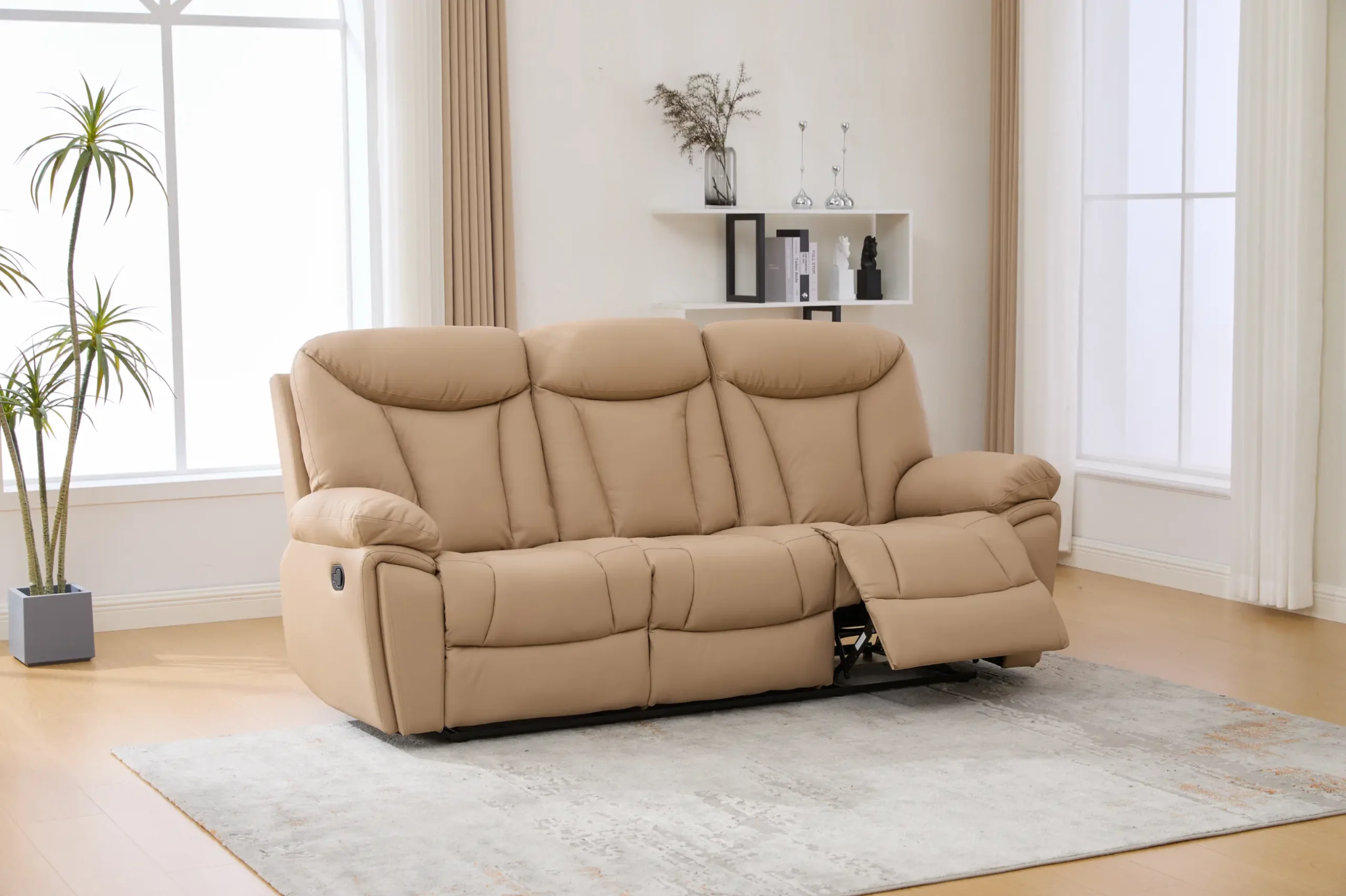
This guide explores the decisions worth making before ordering a natural leather sofa. There is no single model that suits everyone. The aim is to help you recognise which features matter to your household, then compare options on a sensible basis.
Measure your room before browsing designs
Start with the space the sofa will occupy. Measure the wall behind it, the available depth and the walking routes around it. Think about doors, windows, storage units and how people move between the sofa, a coffee table and other furniture.
A useful trick is to outline the proposed footprint on the floor with removable tape or sheets of paper. This gives a more realistic sense of scale than dimensions on a product page alone. Remember that two sofas with the same overall width may have very different usable seat widths because of their arms and frame design.
Delivery deserves equal attention. Check the entrance, hallways, stairs, lift dimensions and tight corners. Ask whether the model arrives in sections, what assembly is required and whether its largest component will fit through your home. A sofa that fits a room on paper still needs to reach it safely.
Two-seater, three-seater or a sofa-and-armchair arrangement?
A two-seater leather sofa may be suitable for a compact living room, especially when paired with an armchair. A three-seater leather sofa offers a longer seating area, but the word “three-seater” does not tell you how much space each person actually gets. Wide arms or strongly contoured seats can change how the furniture feels in use.
For a larger room, combining a sofa with one or two armchairs can create a flexible conversation area. An armchair may be positioned towards a window, placed near a reading lamp or moved to accommodate visitors.
Compare the actual seat dimensions rather than relying on category names. Three separate seat cushions do not automatically mean three adults will all be equally comfortable during an extended evening.
Comfort is more than softness
The overall experience of sitting on a sofa is shaped by seat height, seat depth, backrest angle, arm position, cushioning and personal preference. A deep, relaxed seat can be inviting for one person and awkward for someone who prefers their feet firmly on the floor.
If you can, sit on the sofa for several minutes in the positions you would use at home. Can your feet rest comfortably? Does your back feel supported without having to slide forward? Can you turn, change posture and stand up naturally? These small movements often reveal more than a short showroom test.
When buying remotely, request seat-height and seat-depth measurements in addition to the overall size. Side photographs can also help you assess the angle of the backrest and how far the cushions extend.
Understanding natural leather finishes
Natural leather upholstery is not a single, uniform material. Surface treatments influence its texture, colour consistency and response to everyday wear.
Aniline leather typically shows more of the natural grain and individual marks of the hide, while also generally requiring greater care. Semi-aniline leather may preserve much of that appearance while incorporating additional surface protection; exact characteristics depend on the manufacturer. Pigmented leather often has a more consistent colour and a more defined surface finish.
These terms should not be turned into a simplistic quality ranking. The most suitable finish depends on how and where the furniture will be used. A frequently used family sofa may call for different practical considerations from a piece in a quieter sitting room.
Ask the seller to identify the leather finish, explain the care requirements and clarify which upholstered areas use the specified material. If that information is missing from the listing, obtain it before deciding. A physical sample can be particularly valuable when the texture or colour is central to your choice.
Natural markings are not the same as damage
Natural leather can display variations in grain, small creases and differences in shade. Depending on the finish, these features may be prominent or subtle. They are not automatically evidence of poor quality. Equally, a visible issue should not be dismissed as “natural character” without proper assessment.
When the furniture arrives, examine its seams, cushions, corners and arms. Tears, poor stitching, unexpected surface damage and problems caused in transport are different from the ordinary characteristics of a natural material. Document anything concerning and follow the seller’s inspection and claims process.
Choose colour in the light of your own home
A brown leather sofa can work beautifully with timber and warm finishes. Beige or lighter shades may give a room an airy, understated appearance. Neither approach is universally better. The right choice depends on your floor, walls, curtains, natural light and existing furniture.
Online pictures cannot always reproduce colour accurately because of photographic lighting and screen settings. If precise colour matching matters, ask for a material sample and view it both in daylight and under your usual evening lights.
Keep practical care in mind, too. Some clothing dyes may transfer onto lighter finishes, whereas dust can show more readily on certain darker surfaces. Maintenance needs are shaped by the finish, not colour alone.
Do you need a reclining mechanism?
For households where the sofa is used for longer periods of relaxation, an adjustable backrest or footrest can be an attractive feature. Yet a reclining leather sofa needs to be assessed as a moving piece of furniture, not simply as a fixed sofa with an extra function.
Ask how much clearance the mechanism requires at the front and back, how it operates, whether an electric version needs a power outlet and what servicing may involve. Check that a fully extended footrest will not obstruct the main route through the room.
Functionality should serve daily life. A long list of features offers little advantage if the room layout makes them difficult to use comfortably.
What lies beneath the upholstery?
Leather is only one part of a sofa’s quality and comfort. The frame, support system, cushioning and connections influence how it feels and performs over time. Read whatever construction information is available. Ask whether cushions are fixed or removable, whether replacement components can be sourced and what the warranty actually covers.
No single material label guarantees an excellent sofa. A balanced assessment considers comfortable seating, appropriate construction, clear maintenance guidance and realistic delivery arrangements.
A seven-point checklist before ordering
- Do you have the overall dimensions and the actual seat measurements?
- Will the largest component fit through the entrance, hallway and lift?
- Is the natural leather finish identified, with care instructions available?
- Do the height, depth and backrest suit the people who will use the sofa most?
- Is there sufficient clearance for any reclining mechanism and a suitable power connection if required?
- Are delivery, assembly, warranty and servicing terms clear?
- Have you considered the chosen colour under the lighting in your home?
If a key detail is uncertain, ask for clarification rather than making assumptions. A question answered before delivery is usually much easier to manage than a surprise afterwards.
Frequently asked questions
Is a natural leather sofa suitable for everyday use?
Many models are designed for regular use. However, the requirements and behaviour of particular finishes differ. Match the sofa to the needs of your household and follow the manufacturer’s recommendations rather than relying on broad claims.
Will a leather sofa change appearance over time?
Creasing, changes in surface character and some differences in shade may develop with use. Their extent depends on the leather finish, light exposure and care. Ask the manufacturer what changes are expected for the specific upholstery.
Can photographs tell me everything I need to know?
No. Photographs are valuable for judging style, shape and approximate colour, but they cannot fully explain seat support, internal construction or care requirements. Use them alongside specifications, samples and practical measurements.
Final thoughts
Choosing a leather sofa well means considering your room and your everyday habits before focusing on appearance. Start with accurate measurements, look closely at seating comfort, understand the upholstery finish and clarify the details of delivery and care. This approach makes it far easier to find furniture that will feel right in your home.
The PROMO mēbeles catalogue features different leather sofa and armchair designs. For any particular model, confirm specifications, availability and delivery options to Latvia through its linked original product page.